From Cloud-Native to AI-Enabled Architecture: Building the Foundation for the Next Generation of Digital Services

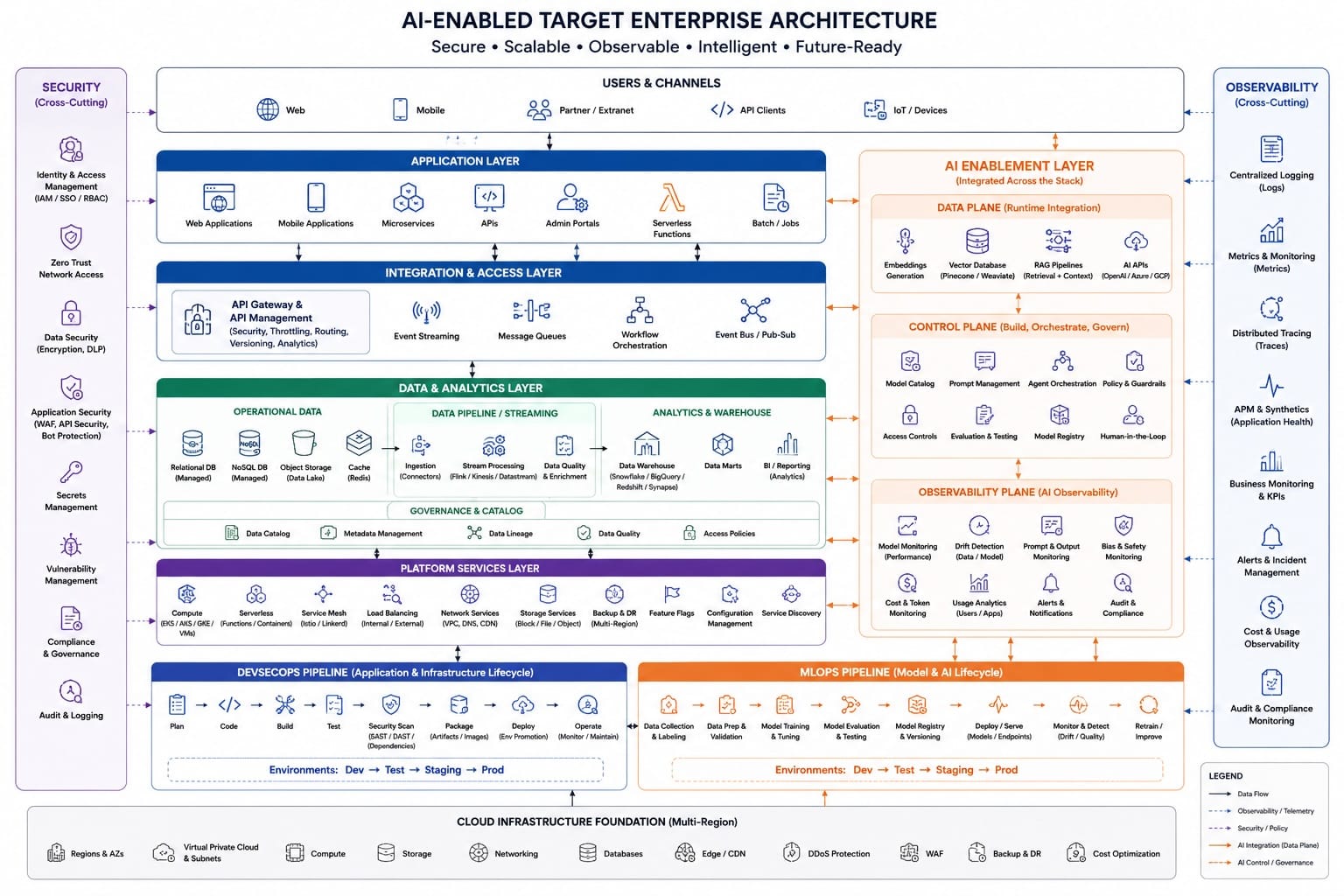
Artificial Intelligence is rapidly moving from experimentation to becoming a core enterprise capability.
Across governments, infrastructure organizations, financial institutions, and large enterprises, the conversation is no longer:
“Should we use AI?”
The real question is now:
“Is our architecture ready for AI at scale?”
Many organizations are still operating on architectures designed primarily for:
- Traditional web applications
- Structured transactional systems
- Human-driven workflows
- Batch integrations
- Static reporting environments
These architectures were not designed to support:
- Real-time intelligence
- AI-assisted decision-making
- Large-scale unstructured data processing
- Agentic workflows
- Generative AI services
- Predictive analytics
- Retrieval-Augmented Generation (RAG)
- AI governance and observability
As a result, many organizations are experiencing fragmented AI pilots, duplicated tooling, security concerns, operational complexity, and growing technical debt.
The future requires something different: AI-enabled enterprise architecture.
AI Transformation Is an Architecture Challenge
One of the biggest misconceptions in the market today is treating AI as a standalone tool deployment.
In reality, sustainable AI adoption is primarily an architectural transformation challenge.
Successful AI implementation requires modernization across:
- Cloud infrastructure
- Data platforms
- Integration patterns
- Security models
- Governance frameworks
- Operating models
- Delivery pipelines
- Observability capabilities
Organizations attempting to “bolt AI on top” of legacy environments often struggle because the underlying architecture lacks:
- Scalability
- Data readiness
- API maturity
- Operational automation
- AI governance controls
- Real-time processing capability
AI does not simply change applications. AI changes the architecture itself.
The Evolution Toward AI-Enabled Architecture
Traditional cloud transformation focused on:
- Infrastructure modernization
- Cost optimization
- Virtualization and migration
- Containerization
- DevOps adoption
The next evolution extends cloud-native architecture into an intelligent digital platform capable of supporting AI workloads and intelligent services.
This evolution introduces several new architectural layers and operating capabilities.
Core Principles of AI-Enabled Architecture
1. Cloud-Native by Design
AI workloads require elasticity, distributed processing, and rapid provisioning.
Modern AI-enabled environments should leverage:
- Container platforms
- Serverless services
- Event-driven architecture
- Managed platform services
- Infrastructure as Code (IaC)
- Automated scaling
Cloud-native architecture provides the flexibility and operational resilience required for evolving AI workloads.
Major cloud providers such as Amazon Web Services, Microsoft, and Google are increasingly embedding AI capabilities directly into their cloud ecosystems.
2. Data as the Foundation
AI maturity is fundamentally dependent on data maturity.
Without trusted, governed, high-quality data, even the most advanced AI models deliver limited value.
Organizations need to establish:
- Enterprise data governance
- Data quality management
- Metadata management
- Data lineage
- Secure data access models
- Master data management
- Real-time and streaming data pipelines
AI-enabled architectures increasingly require support for:
- Structured data
- Unstructured content
- Vectorized embeddings
- Real-time ingestion
- Semantic search
The data platform becomes the backbone of the AI ecosystem.
3. AI as a Reusable Platform Capability
One common mistake is embedding AI separately into every application.
A better approach is establishing a centralized AI enablement layer composed of reusable enterprise services.
Typical AI platform capabilities include:
- AI/ML model services
- Embedding services
- Vector databases
- Prompt management
- Agent orchestration
- Retrieval-Augmented Generation (RAG)
- AI workflow pipelines
- AI governance and monitoring
This enables organizations to scale AI consistently across multiple business domains while reducing duplication and operational complexity.
The Rise of AI Governance
As AI adoption increases, governance becomes critical.
Organizations are now dealing with entirely new categories of risk:
- Hallucinations
- Prompt injection attacks
- Data leakage
- Model bias
- Explainability concerns
- Intellectual property risks
- Ethical and regulatory challenges
AI governance can no longer be treated as optional.
Best-practice AI-enabled architectures should incorporate:
- Responsible AI policies
- Human oversight mechanisms
- Model lifecycle governance
- AI observability
- Access controls
- Auditability
- Bias monitoring
- Security guardrails
Frameworks such as the National Institute of Standards and Technology (NIST) are becoming increasingly important reference points for enterprise AI governance.
DevSecOps Must Evolve into AI Operations
Traditional DevOps pipelines are insufficient for AI-enabled ecosystems.
Organizations now require:
- MLOps
- LLMOps
- AI model versioning
- Prompt lifecycle management
- AI performance monitoring
- Model drift detection
- GPU workload optimization
- AI cost observability
AI systems introduce a continuously evolving operational environment that requires significantly higher maturity in automation and monitoring.
This is where DevSecOps, observability, and AI operations converge.
A Reference AI-Enabled Target Architecture
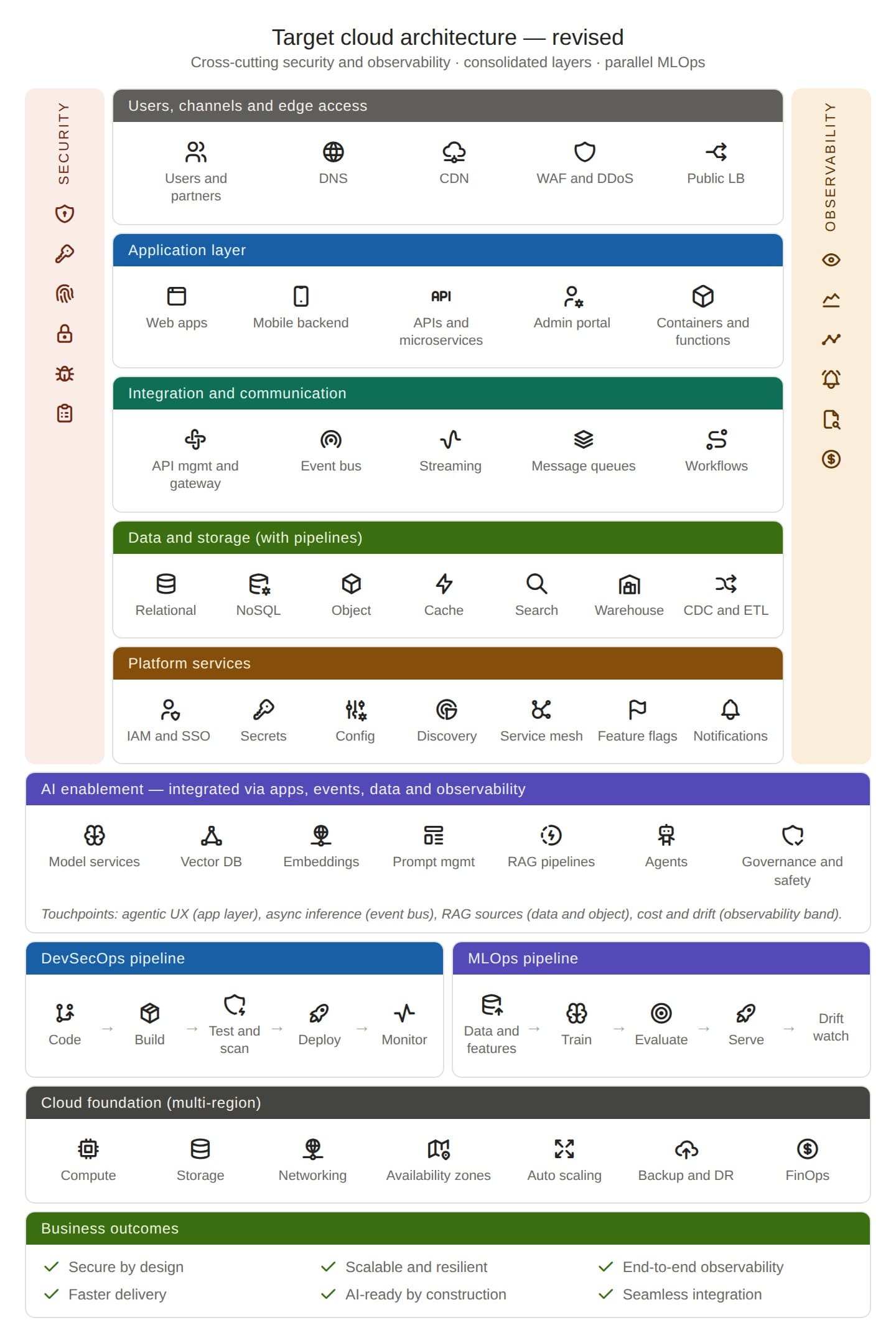
A modern AI-enabled architecture typically includes:
Application Layer
- Web applications
- Mobile platforms
- APIs
- Microservices
- Administrative interfaces
Integration Layer
- API gateways
- Event streaming
- Workflow orchestration
- Message queues
- Service mesh capabilities
Data Layer
- Managed databases
- Object storage
- Analytics platforms
- Streaming pipelines
- Vector databases
AI Enablement Layer
- Hosted AI models
- Embedding services
- RAG pipelines
- Agent orchestration
- Prompt management
- AI governance services
Cross-Cutting Capabilities
- Identity and access management
- Zero trust security
- Encryption
- Centralized observability
- Infrastructure automation
- Compliance monitoring
The architecture must be modular, scalable, secure, and extensible.
AI Architecture Is Also a Business Transformation Strategy
AI-enabled architecture is not only a technology initiative.
It directly impacts:
- Service delivery models
- Workforce productivity
- Decision-making speed
- Customer experience
- Infrastructure operations
- Risk management
- Innovation capability
Organizations that establish strong AI-ready foundations today will be significantly better positioned to:
- Scale AI safely
- Reduce implementation fragmentation
- Accelerate digital transformation
- Improve operational resilience
- Enable intelligent automation
- Adapt to future AI capabilities
Final Thoughts
The transition from traditional enterprise architecture to AI-enabled architecture represents one of the most important technology shifts of the next decade.
The organizations that succeed will not necessarily be the ones deploying the most AI tools.
They will be the organizations that:
- Build strong architectural foundations
- Establish trusted data ecosystems
- Embed governance early
- Operationalize AI responsibly
- Design for scalability and adaptability
AI transformation is ultimately an enterprise architecture transformation.
And the time to prepare that foundation is now.