A Practical Architecture and Operating Model for Small Businesses

Most small businesses do not need enterprise-scale AI architecture.
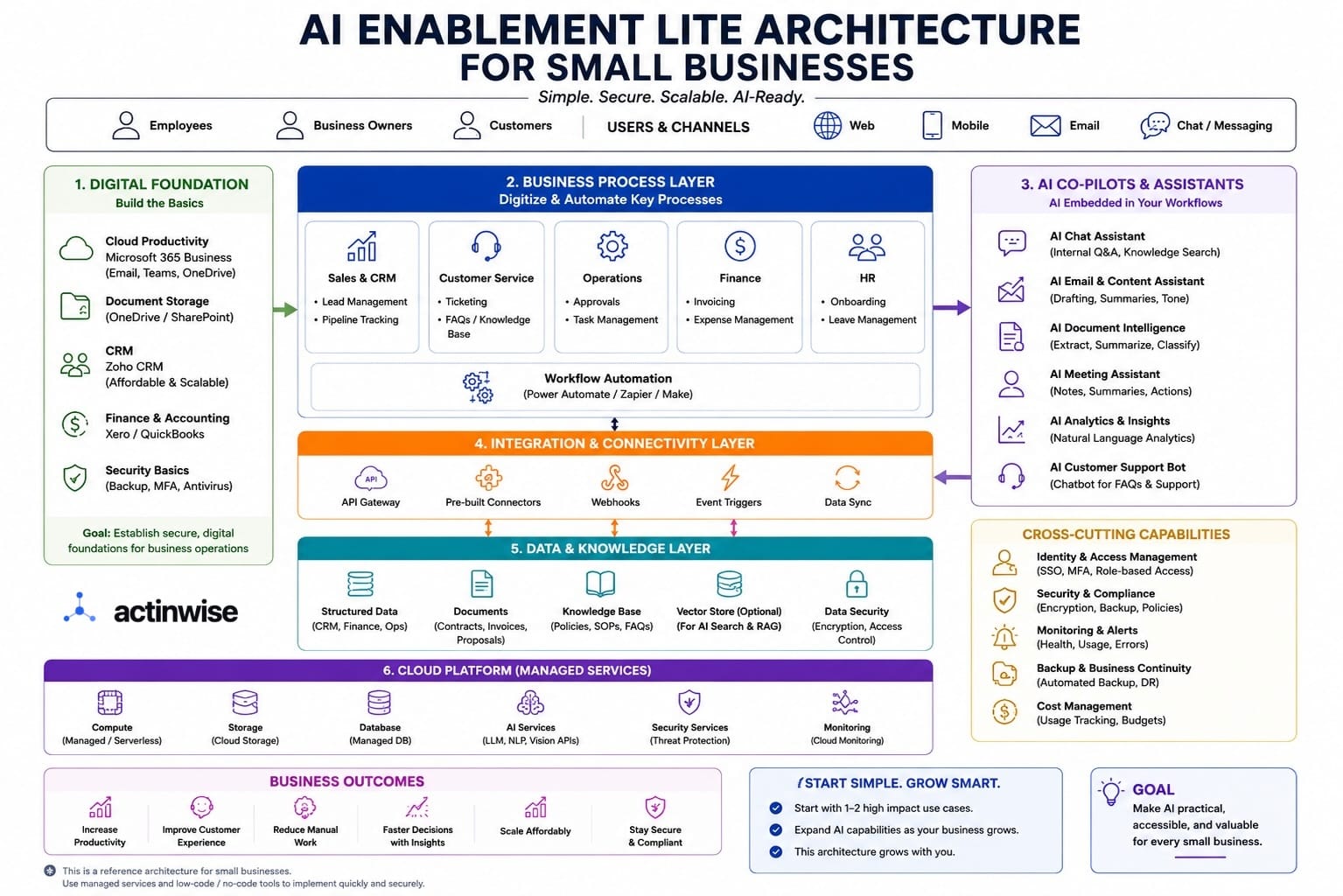
Important Note:
The solutions presented are intended as reference examples only. They are not universal recommendations, as every SME has unique operational requirements, technical maturity levels, and budget considerations. The most suitable solution should be tailored to each organization’s specific business needs and growth objectives.
What they need is:
- A practical roadmap
- Affordable implementation patterns
- Managed services
- Low operational complexity
- Fast business value
- Security without enterprise overhead
The most effective approach is a layered AI enablement model that allows SMEs to progressively mature their capabilities over time.
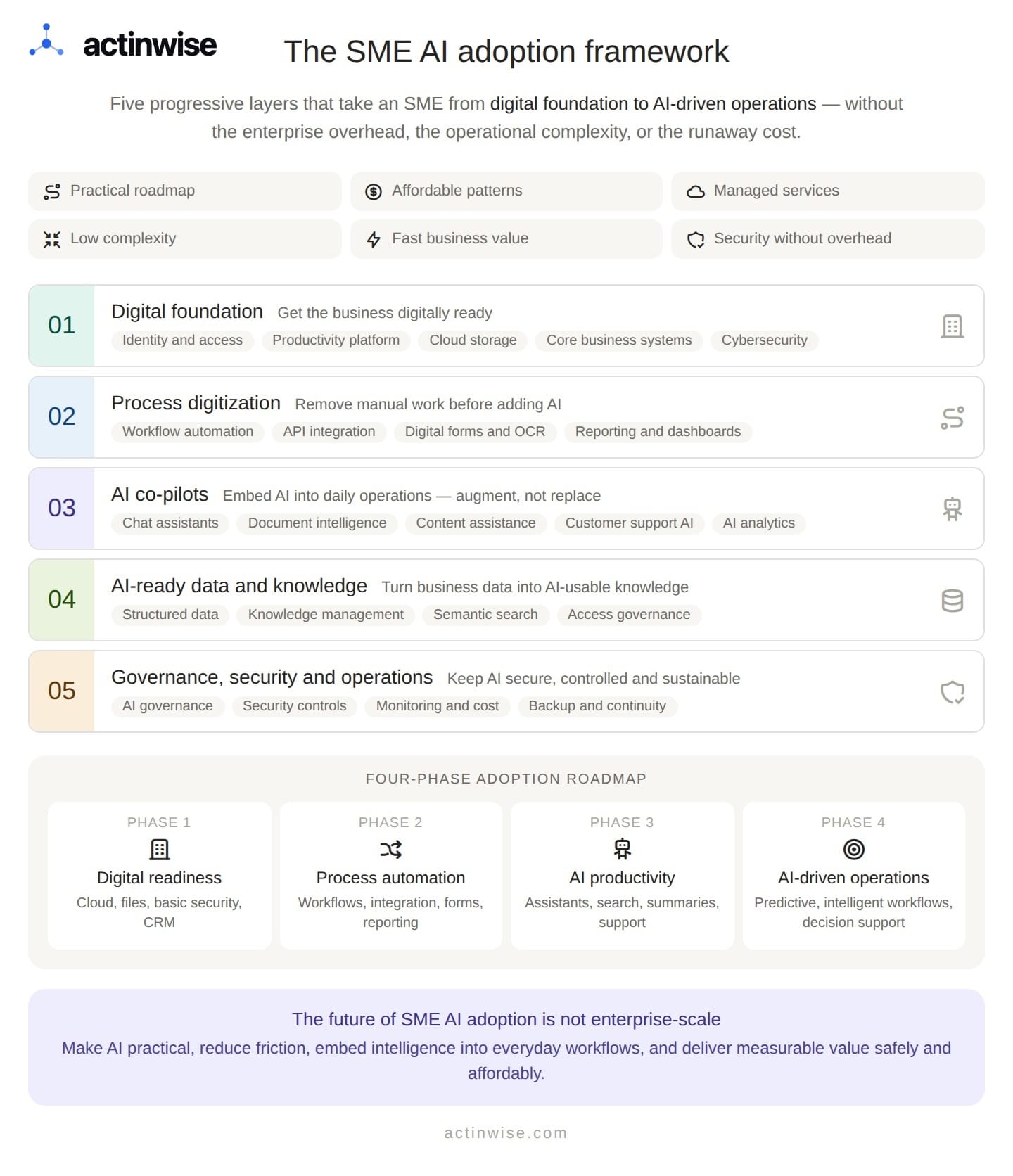
Layer 1 — Digital Foundation
“Get the Business Digitally Ready”
This layer establishes the operational baseline required before AI can deliver meaningful value.
Without this layer:
- Data is fragmented
- Processes remain manual
- AI outputs become unreliable
- Automation fails quickly
Core Capabilities
Identity & Access
Establish secure user access and authentication.
Capabilities:
- Single Sign-On (SSO)
- Multi-Factor Authentication (MFA)
- Role-based access
- Password management
Productivity Platform
Centralized collaboration and communication.
Capabilities:
- Shared calendars
- File collaboration
- Team chat
- Video conferencing
Cloud File Storage
Centralized document management.
Capabilities:
- Shared folders
- Permission management
- Backup
- Versioning
- Searchability
Core Business Systems
Digitize operational systems.
Capabilities:
- CRM
- Accounting
- HR
- Project management
- Ticketing
Basic Cybersecurity
Minimum viable security posture.
Capabilities:
- Endpoint protection
- Device management
- Backup
- Anti-phishing
- Secure WiFi
- VPN
SME Solution Options — Layer 1
Very Small Business (1–10 employees)
Typical Stack:
- Google Workspace
- Dropbox
- QuickBooks
- Trello
Characteristics:
- Low cost
- Simple setup
- Minimal IT support
Growing SME (10–50 employees)
Typical Stack:
- Microsoft 365
- HubSpot
- Xero
- Atlassian Jira/Confluence
Characteristics:
- Better governance
- Integration-ready
- More scalable
Advanced SME (50–250 employees)
Typical Stack:
- Microsoft / Amazon Web Services
- Managed Identity Provider
- Centralized endpoint management
- SIEM-lite monitoring
Characteristics:
- Multi-system integration
- Governance controls
- Security maturity
Layer 2 — Process Digitization & Workflow Automation
“Remove Manual Work Before Adding AI”
AI should not automate broken processes.
This layer focuses on:
- Standardization
- Workflow automation
- Data consistency
- Operational efficiency
Core Capabilities
Workflow Automation
Automate repetitive business tasks.
Examples:
- Invoice approvals
- Customer onboarding
- Lead routing
- Notifications
- Form processing
API & Integration
Connect business systems.
Capabilities:
- SaaS integration
- Event triggers
- Data synchronization
- Webhooks
Digital Forms & Document Processing
Convert manual paperwork into digital workflows.
Capabilities:
- OCR
- Form extraction
- E-signature
- Approval workflows
Reporting & Dashboards
Provide visibility into operations.
Capabilities:
- KPI dashboards
- Operational metrics
- Real-time alerts
SME Solution Options — Layer 2
Low-Code / No-Code Approach
Tools:
- Zapier
- Make
- Microsoft
- Airtable
Best for:
- Non-technical businesses
- Fast deployment
- Budget-sensitive SMEs
Structured Automation Approach
Tools:
- Workato
- Celigo
- n8n
- API-first SaaS ecosystem
Best for:
- Multi-system operations
- Scaling businesses
- Governance needs
Layer 3 — AI Co-Pilots & AI-Assisted Workflows
“Embed AI into Daily Business Operations”
This is where SMEs often experience their first major AI productivity gains.
The goal is:
AI augmentation, not AI replacement.
Core Capabilities
AI Chat Assistants
Internal business Q&A.
Use cases:
- Policy search
- SOP retrieval
- Internal knowledge assistant
AI Document Intelligence
Automate document handling.
Use cases:
- Invoice extraction
- Proposal summarization
- Contract review
- Form classification
AI Content Assistance
Improve communication productivity.
Use cases:
- Email drafting
- Marketing copy
- Proposal writing
- Meeting summaries
AI Customer Support
AI-assisted service operations.
Use cases:
- Chatbots
- FAQ assistants
- Ticket triage
AI Analytics
Natural language insights.
Use cases:
- Ask-your-data
- Predictive trends
- Business summaries
SME Solution Options — Layer 3
Embedded AI SaaS
Tools:
- Microsoft
- Notion AI
- Canva AI
Best for:
- Immediate productivity gains
- Minimal implementation
AI Workflow Platform
Tools:
- OpenAI APIs
- Retrieval-Augmented Generation (RAG)
- Vector databases
- Custom workflow orchestration
Best for:
- SMEs with unique workflows
- Industry-specific AI use cases
Layer 4 — AI-Ready Data & Knowledge Layer
“Turn Business Data into AI-Usable Knowledge”
This layer becomes critical once AI usage expands.
Core Capabilities
Structured Data Management
Operational business data.
Examples:
- CRM
- Finance
- Operations
- HR
Knowledge Management
Unstructured information.
Examples:
- Policies
- Contracts
- Procedures
- Technical documentation
Search & Retrieval
AI-ready search capability.
Capabilities:
- Semantic search
- Vector embeddings
- Context retrieval
Governance & Access Control
Protect business information.
Capabilities:
- Access policies
- Retention rules
- Data classification
SME Solution Options — Layer 4
Lightweight Knowledge Hub
Tools:
- Notion
- Confluence
- SharePoint
Best for:
- Centralized business knowledge
- AI search enablement
AI-Ready Knowledge Platform
Tools:
- Vector databases
- RAG pipelines
- AI search layers
- Metadata tagging
Best for:
- Knowledge-heavy SMEs
- Consulting firms
- Professional services
- Healthcare and legal workflows
Layer 5 — Governance, Security & Operations
“Keep AI Secure, Controlled, and Sustainable”
Many SMEs underestimate this layer.
But AI introduces new risks:
- Data leakage
- Shadow AI usage
- Prompt exposure
- Hallucinations
- Compliance risks
Core Capabilities
AI Governance
Capabilities:
- AI usage policy
- Human review workflows
- Prompt guidelines
- AI approval processes
Security Controls
Capabilities:
- MFA
- Data encryption
- Access logging
- Secure APIs
Monitoring & Observability
Capabilities:
- Usage monitoring
- Cost tracking
- AI output review
- Error monitoring
Backup & Business Continuity
Capabilities:
- Data backup
- Disaster recovery
- SaaS resilience planning
SME Solution Options — Layer 5
Lightweight Governance
Best for:
- Small teams
- Early-stage AI adoption
Capabilities:
- AI acceptable-use policy
- Basic approval workflows
- MFA enforcement
Managed AI Governance
Best for:
- Regulated industries
- Growing SMEs
Capabilities:
- AI monitoring
- Security baselines
- Compliance reporting
- Managed operations support
Recommended SME AI Adoption Roadmap
Phase 1 — Digital Readiness
- Cloud productivity
- Centralized files
- Basic security
- CRM/accounting modernization
Phase 2 — Process Automation
- Workflow automation
- Integration
- Digital forms
- Reporting
Phase 3 — AI Productivity
- AI assistants
- AI search
- AI summarization
- Customer support AI
Phase 4 — AI-Driven Operations
- Predictive analytics
- Intelligent workflows
- AI-powered decision support
- Custom AI use cases
The future of SME AI adoption is not about building enterprise-scale AI platforms.
It is about:
- Making AI practical
- Reducing operational friction
- Embedding intelligence into everyday workflows (not just artificial 😄)
- Delivering measurable business value safely and affordably