What Happens When a Company Has No AI Governance?

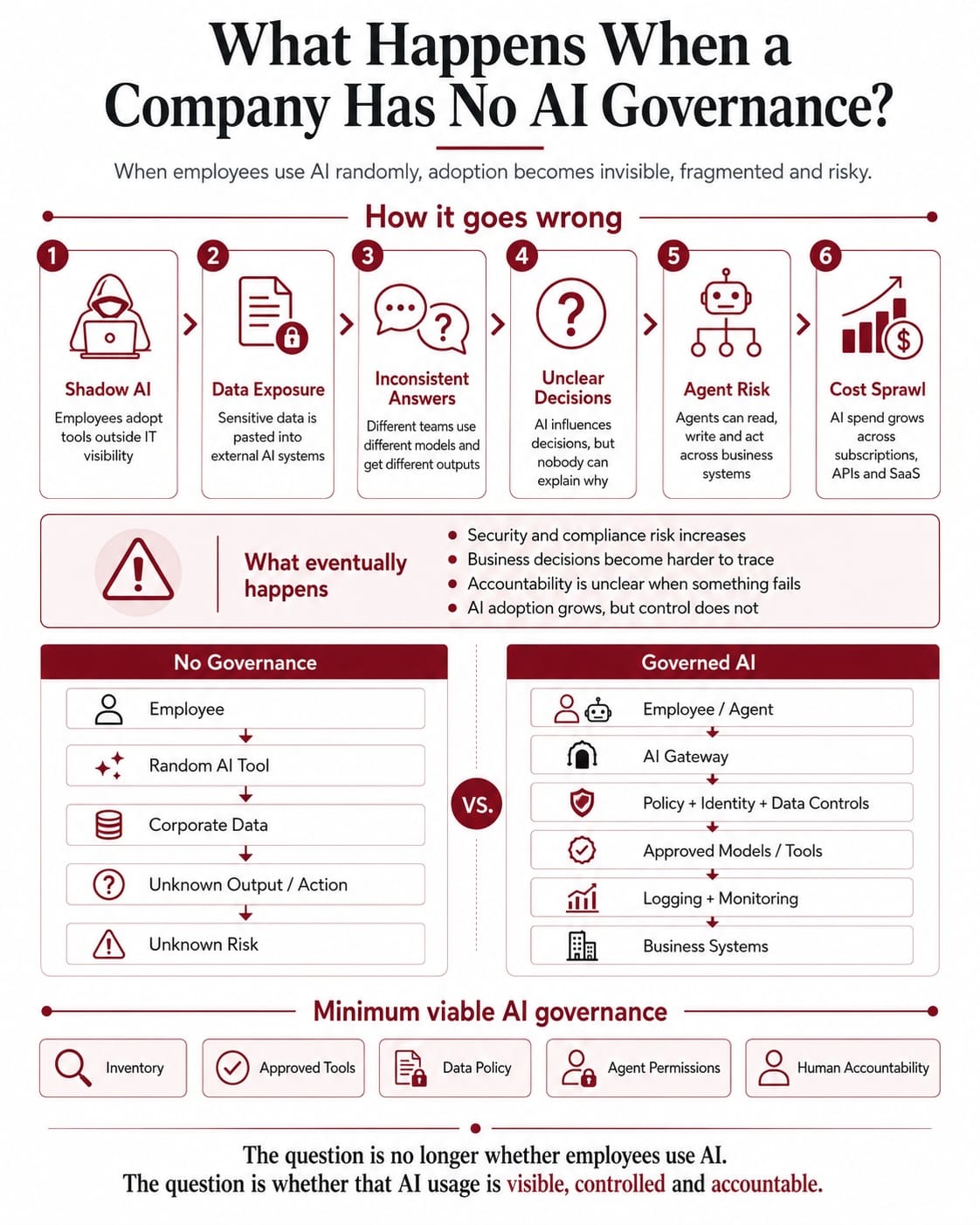
AI adoption inside organisations is no longer something that happens only through formal technology programmes.
Employees are already using ChatGPT, Claude, Gemini, Copilot, coding assistants, browser extensions, meeting assistants, AI search tools and increasingly AI agents.
In many companies, this adoption is happening faster than governance can keep up.
The risk is not that employees are using AI.
The risk is that the organisation does not know which AI is being used, what data is being shared with it, what decisions it is influencing, or what actions it is allowed to perform.
When a company has no AI governance, AI usage does not disappear.
It becomes invisible.
Imagine a company with no AI governance
Consider a mid-sized organisation with 500 employees.
Management encourages staff to experiment with AI because it can improve productivity.
There is no formal AI policy.
There is no approved AI tool list.
There is no AI inventory.
There are no clear rules explaining what company information can be entered into an AI system.
At first, nothing appears particularly problematic.
Employees simply begin finding tools that help them work faster.
Marketing uses an AI platform to create customer campaigns.
Finance uses an LLM to analyse spreadsheets.
HR experiments with AI to review CVs.
Sales uses a browser extension connected to CRM.
Developers use multiple AI coding assistants.
Legal uses AI to summarise contracts.
Operations builds a small AI agent to automate repetitive administration.
Each decision makes sense individually.
But something different is happening at organisational level.
The company is quietly building an AI estate that nobody is managing.
Shadow AI begins to develop
Most enterprises are familiar with the idea of shadow IT.
Employees adopt applications or cloud services outside formal IT processes because they are easier, faster or more convenient.
AI creates the same problem at significantly greater speed.
Call it Shadow AI.
A marketing employee can create an account with a new AI platform in minutes.
A developer can call a new model API with a credit card.
A department can subscribe to an AI SaaS platform without involving enterprise architecture.
An employee can install an AI browser extension and connect it to existing systems.
A technically capable employee can build an AI agent over a weekend.
Soon the organisation may have dozens of AI products, models and agents operating across the business.
Yet management may believe:
“We use Microsoft Copilot.”
The real environment might look more like:
Marketing → ChatGPT + marketing AI tools
Finance   → Claude + spreadsheet assistants
HR        → recruitment AI
Sales     → CRM AI extensions
IT        → Copilot
Developers → Copilot + Claude + multiple model APIs
Legal     → document AI
Operations → custom agents
There is no longer a single AI environment.
There is an unmanaged ecosystem.
And the organisation may have very little visibility into it.
Corporate information starts moving into systems nobody understands
The next problem is data.
Employees are normally trying to complete a task.
They are not thinking about enterprise data architecture every time they interact with an AI tool.
A finance employee may upload a spreadsheet containing revenue forecasts.
A developer may paste proprietary source code into a chatbot.
Sales may provide customer information to an AI assistant.
Legal may upload a commercial agreement.
HR may ask an AI system to analyse employee information.
Marketing may upload customer segmentation data to generate campaign ideas.
Each action might save significant time.
But collectively they create a difficult question:
Where is the organisation's information going?
Without governance, the company may not know:
- which external AI providers hold company data
- what information employees have submitted
- whether conversations are retained
- where data is processed
- whether information is used by third-party systems
- which models have access to sensitive information
- whether regulatory or contractual obligations are being violated
The problem is not necessarily that an employee intentionally ignored security.
There may simply have been no clear architecture or policy explaining what was acceptable.
Every department starts building its own version of AI
The organisation then develops another problem.
Different teams begin using different models.
One department uses GPT.
Another uses Claude.
Another uses Gemini.
Developers experiment with open-source models.
A business unit buys a specialist AI SaaS product.
Someone builds an internal RAG system.
Someone else builds an agent.
Each system has different:
- models
- prompts
- knowledge sources
- context
- security controls
- retention policies
- evaluation methods
- reliability characteristics
Two employees can ask apparently identical business questions and receive completely different answers.
At that point, AI has quietly become part of the enterprise decision architecture.
But the organisation is not treating it as enterprise architecture.
AI starts influencing decisions without accountability
Initially, AI may only help employees draft emails or summarise documents.
Eventually it starts influencing decisions.
A manager asks AI to compare candidates.
A salesperson asks AI which customers should receive a discount.
Finance uses AI-generated analysis when preparing a forecast.
A developer accepts an AI-generated implementation.
An operations employee follows an AI recommendation.
Then one day somebody asks:
Why was this decision made?
The answer might be:
“The AI recommended it.”
That answer immediately creates more questions.
Which AI?
Which model?
Which model version?
What prompt was used?
What company information was provided?
What sources did it retrieve?
What assumptions did it make?
Was the answer evaluated?
Did a human review it?
Who ultimately approved the decision?
Without governance, the organisation may not be able to answer any of these questions.
The AI recommendation influenced the business.
But the decision path is no longer traceable.
Agents change the risk completely
This becomes more important as organisations move from generative AI to agentic AI.
A chatbot primarily produces information.
An agent can perform actions.
That distinction matters.
An employee might connect an agent to:
- SharePoint
- Google Drive
- CRM
- ERP
- databases
- cloud infrastructure
- payment systems
- internal APIs
The agent may then be allowed to:
- read documents
- create records
- modify customer information
- send emails
- approve workflows
- create invoices
- execute code
- call external APIs
- trigger business processes
Now the governance question is no longer only:
What information can the AI see?
It becomes:
What is the AI allowed to do?
Traditional employees receive identities, permissions, roles and access controls.
Agents increasingly need the same discipline.
An autonomous agent with poorly defined permissions is effectively a new digital employee operating inside the organisation.
Except it may operate much faster than a human.
AI cost also becomes fragmented
Security and compliance receive most of the attention around AI governance.
But there is another issue.
Cost.
Without governance, departments independently purchase:
- AI subscriptions
- model API credits
- coding assistants
- AI SaaS platforms
- document AI tools
- marketing AI tools
- meeting assistants
- AI infrastructure
The company may know how much it spends on cloud infrastructure.
It may know how much it spends on Microsoft licences.
Yet it may have no accurate answer to:
How much are we spending on AI?
More importantly:
What business outcome are we receiving for that spend?
AI costs can become distributed across corporate cards, SaaS contracts, cloud accounts and departmental budgets.
The organisation can therefore have significant AI expenditure while having very little understanding of AI economics.
Eventually something goes wrong
Most organisations do not discover governance gaps during normal operation.
They discover them during an incident.
An AI-generated customer response contains incorrect information.
Sensitive information is submitted to an unapproved platform.
An AI-generated piece of code introduces a vulnerability.
A recruitment tool makes questionable recommendations.
An agent sends an email that should never have been sent.
A model generates an incorrect financial calculation.
A department makes a decision using information that cannot be reproduced.
Then management asks the obvious question:
Who was responsible?
The employee?
The department?
IT?
Security?
Enterprise architecture?
The AI vendor?
The model provider?
The CIO?
If accountability was not defined before AI was introduced, it will usually be debated after something has already failed.
That is not governance.
That is incident response.
The solution is not banning AI
An organisation could respond by blocking every external AI service.
That may appear safe.
In practice, it can simply create more Shadow AI.
Employees adopt AI because it solves real problems.
If the approved environment makes AI difficult to use while public tools remain dramatically more productive, employees will find ways to use those tools.
Governance should therefore not be designed primarily to stop AI.
It should provide a controlled path for using it.
The question should move from:
“How do we prevent employees from using AI?”
to:
“How do we let employees use AI safely, efficiently and accountably?”
Start with visibility
The first requirement is surprisingly simple.
Know what exists.
Before creating complex AI governance committees or large policy frameworks, organisations should be able to answer:
- Which AI products are being used?
- Which models are being used?
- Which departments are using them?
- What information can those systems access?
- Which systems are connected to company data?
- Which AI agents exist?
- What actions can those agents perform?
- Who owns each system?
- How much does it cost?
- What business process does it support?
If those questions cannot be answered, the organisation does not yet have control of its AI environment.
Minimum viable AI governance
AI governance does not need to start with hundreds of pages of policy.
A practical governance layer can begin with several basic controls.
| Control | Question it answers |
|---|---|
| AI inventory | What AI systems do we have? |
| Approved tools | Which AI platforms can employees use? |
| Data policy | What information can be provided to AI? |
| Model governance | Which models are appropriate for which workloads? |
| Identity and access | Who can use each system? |
| Agent permissions | What can autonomous systems do? |
| Logging | What information went into and came out of the system? |
| Evaluation | Is the AI reliable enough for its intended purpose? |
| Cost controls | What are we spending? |
| Human accountability | Who owns the final outcome? |
This creates a foundation.
Governance can then mature as AI adoption grows.
Architecture also matters
Governance cannot exist only as a policy document.
Some controls need to become part of the technical architecture.
Instead of every employee, application and agent connecting independently to external models, organisations may increasingly introduce a governed AI layer.
For example:
Employee / Application / Agent
              ↓
          AI Gateway
              ↓
    Identity + Policy Controls
              ↓
     Data Protection Controls
              ↓
     Approved Models / Tools
              ↓
 Evaluation + Logging + Monitoring
              ↓
         Business Systems
The exact architecture will differ between organisations.
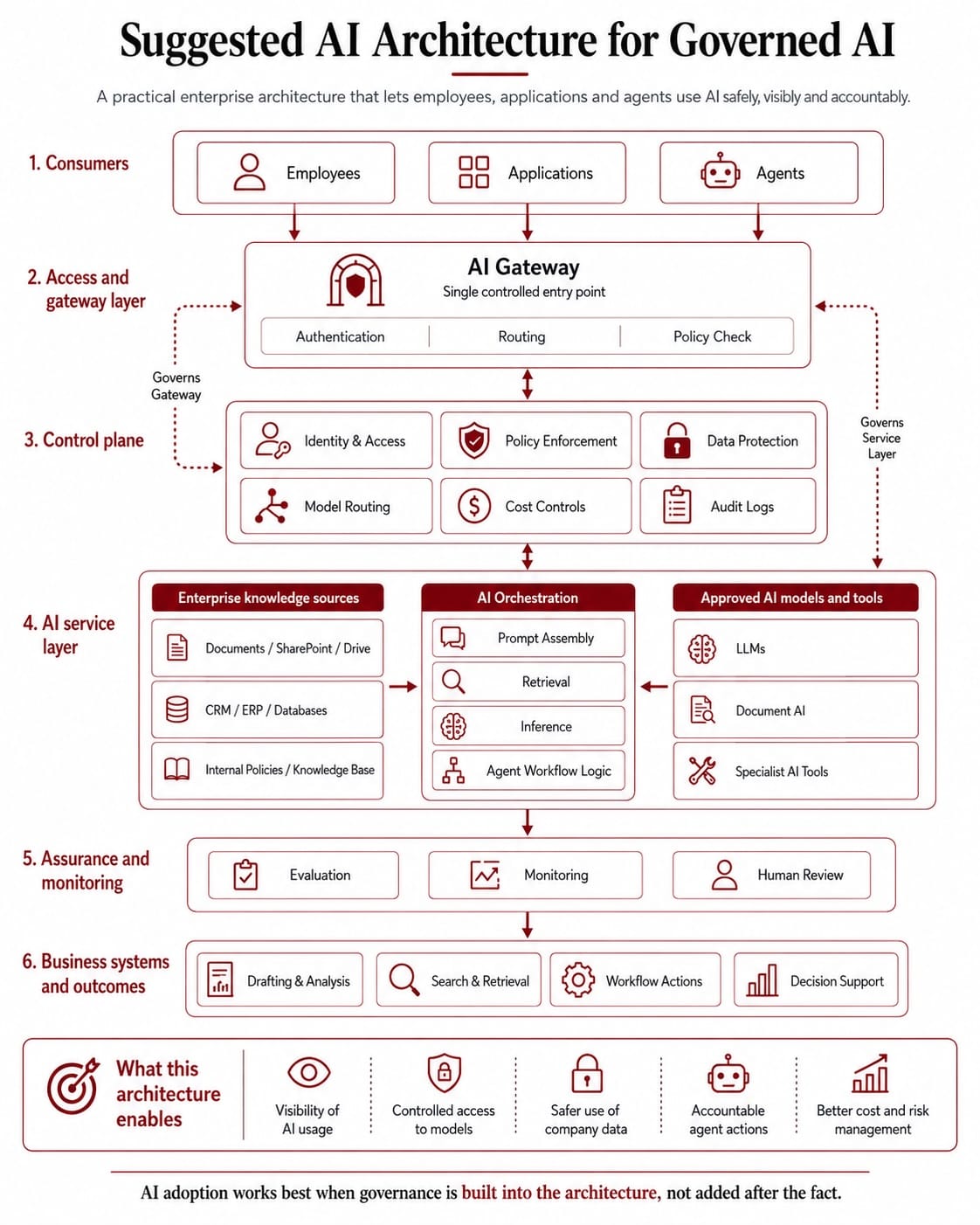
But the principle remains the same.
AI should not become an invisible parallel technology estate operating outside normal enterprise controls.
AI governance is ultimately an operating model
The most important point is that AI governance is not simply an AI policy.
It is the operating model around how an organisation adopts AI.
It defines:
What AI can be used.
What data AI can access.
What decisions AI can influence.
What actions agents can perform.
How AI systems are evaluated.
How AI spending is controlled.
And who remains accountable for the result.
The objective should not be to slow down AI adoption.
Good governance should do the opposite.
It should allow the organisation to adopt AI faster because security, architecture, data and accountability questions have already been addressed.
The real risk is unmanaged adoption
Companies sometimes debate whether they are ready to adopt AI.
That debate is becoming increasingly disconnected from reality.
Employees are already adopting it.
Business units are already buying it.
Developers are already integrating it.
And agents are beginning to interact directly with enterprise systems.
The question is therefore no longer whether AI will enter the organisation.
It already has.
The real question is whether that AI usage will be visible, controlled and accountable — or invisible, fragmented and unmanaged.